

When Theology Meets Washington: A Career Transforming Week
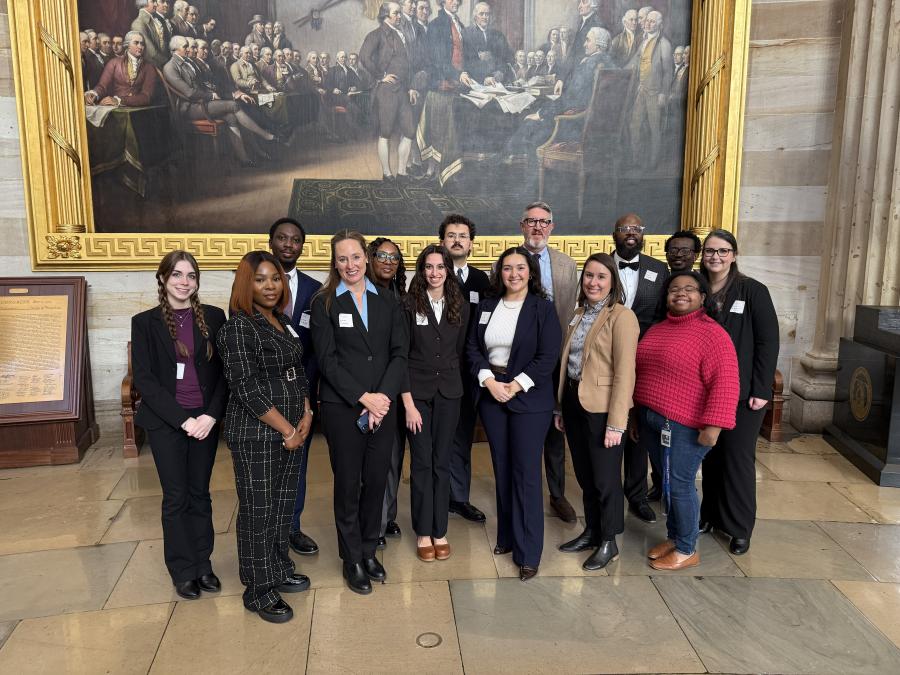
In partnership with Baylor's George W. Truett Theological Seminary’s Theology, Ecology, and Food Justice (TEFJ) master’s degree, the Baylor Collaborative on Hunger and Poverty offers TEFJ 7340 The Intersection of Theology, Food Justice, and Public Policy—an immersive, graduate-level course open to students from across Baylor University introducing students to the theology and practices of food activism as it connects to public policy and advocacy. During the course, students spend a week in Washington, D.C. engaging with leaders in food justice initiatives on a national and global scale. In January 2026, 11 students completed the course. Graham Butterfield, a first-year student in the TEFJ master's program, shared his reflections about his experience.
“When I think about career aspirations, I have often been conflicted and thought of various paths. Having an undergraduate degree in political science from Baylor University, I used to think that I was going to go to law school. However, after taking an environmental policy class in undergrad, I knew I wanted to work in the policy or advocacy space rather than being a lawyer. When I found out about the TEFJ program at Baylor, I knew it was something I could see myself doing, and I knew it was going to be great preparation for a career working in the food policy space.
This course has truly been transformational.

Before the course, I knew I wanted to work in the food policy and advocacy space, but I always pictured myself working in a local non-profit. After getting to go to DC and take this course, I know I want to work in that city. Through meeting with faith-based organizations, I know that my faith is something that should drive my work and something I shouldn’t have to hide.
My faith has played the biggest part in drawing me to care for creation, and particularly, my prayer and meditation. For me, nature and creation are where I feel the presence of God; it is where I can find peace and reflect.
I was drawn to issues of food justice because I believe that it is solvable in my lifetime (at least in the US), and it is something that God calls us to do. Feeding your neighbor is a loving act.
From the first day in DC, I knew this class was going to be transformational. Being able to meet with public, private, and nonprofit sectors on the first day really set the tone for the trip in all the best ways; it highlighted that to end hunger, it requires multisectoral collaboration. There are two moments I found to be most meaningful. The first was being able to meet with Walmart.
Prior to this course and meeting with Walmart, I was skeptical of the private sector, and I didn’t really understand how the private sector fit in. However, after meeting with Walmart, I have a better understanding of the good work they are doing and how they are using their resources to address hunger issues in the US. The people working at Walmart…have a wealth of experience…to address food justice in the US.
The second moment was with meeting the team at Bread for the World. Bread for the World made me feel more comfortable leaning into faith when it comes to discussing food justice. As I mentioned before, my faith is what drives me and what got me passionate about care for creation and food justice issues. The team at Bread for the World truly inspired me to lean into my faith more, be bold in my faith, and they encouraged me not to hide my faith.
If I had the chance to talk with folks considering this course, I would tell them overwhelmingly that they have to take it. I have never taken a class more transformative and life giving than this course. Being able to have a week of lectures and then going to DC is truly one of a kind; it made it feel as though the lectures came to life. The best part of the course is the people. You get to build great relationships with your classmates, have great conversation, and eat great food.”
The TEFJ 7340 Intersection of Theology, Food Justice, and Public Policy course will be offered again in May 2027.